

To be a friend with animals is to be a friend and a child of the world, connected to it, nourished by it, belonging to it.
-Le Guin, The Beast in the Book
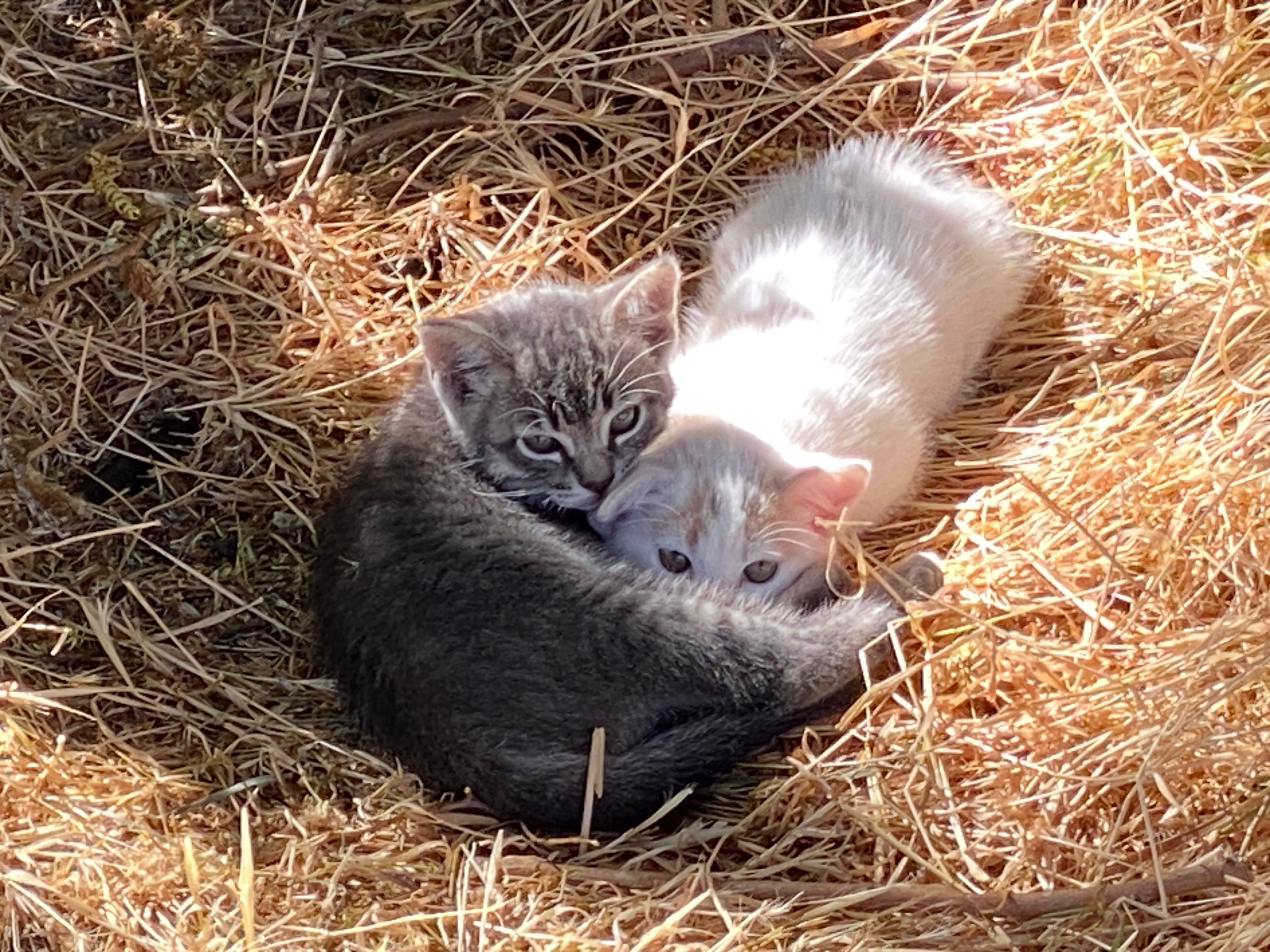
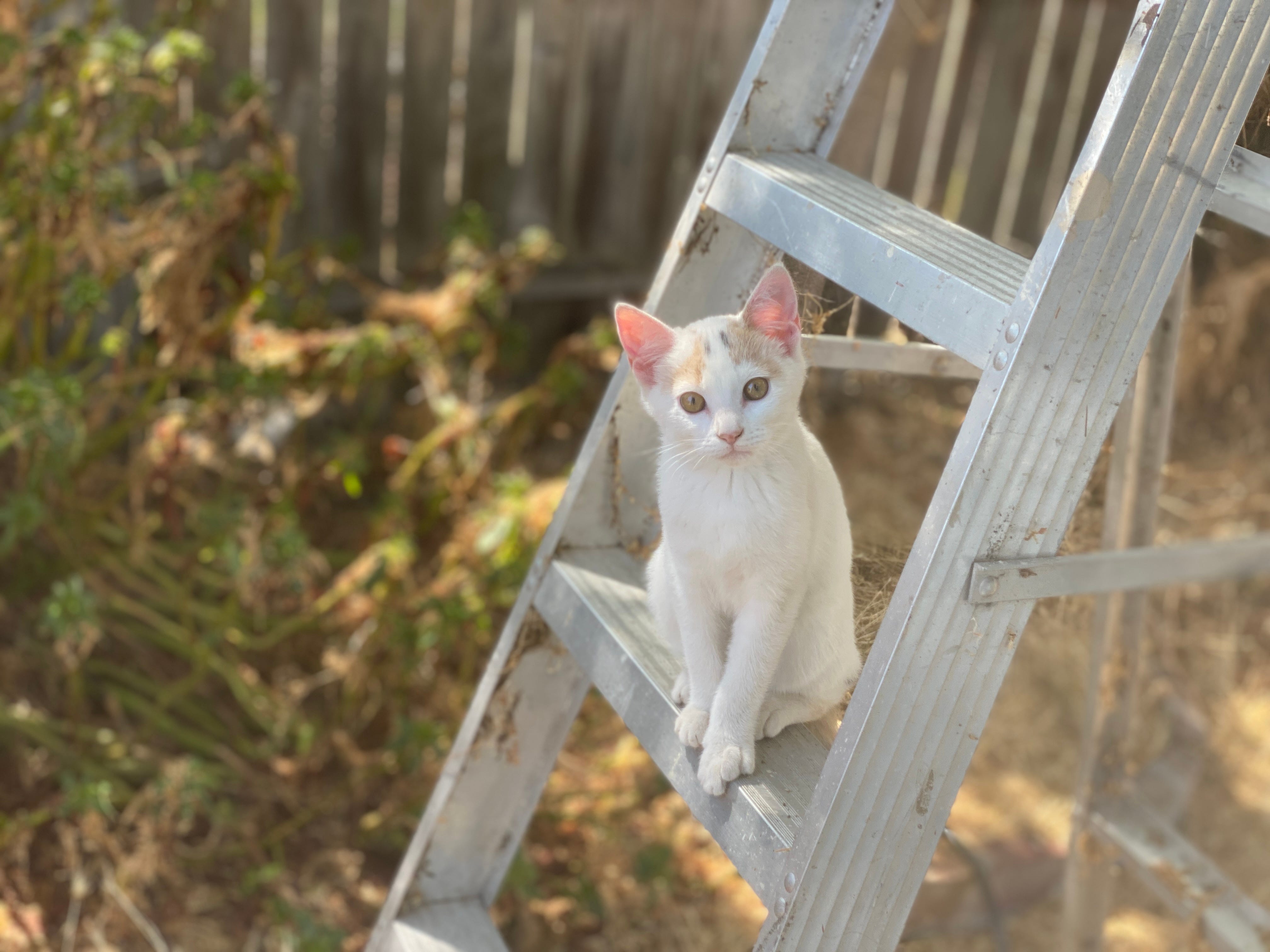
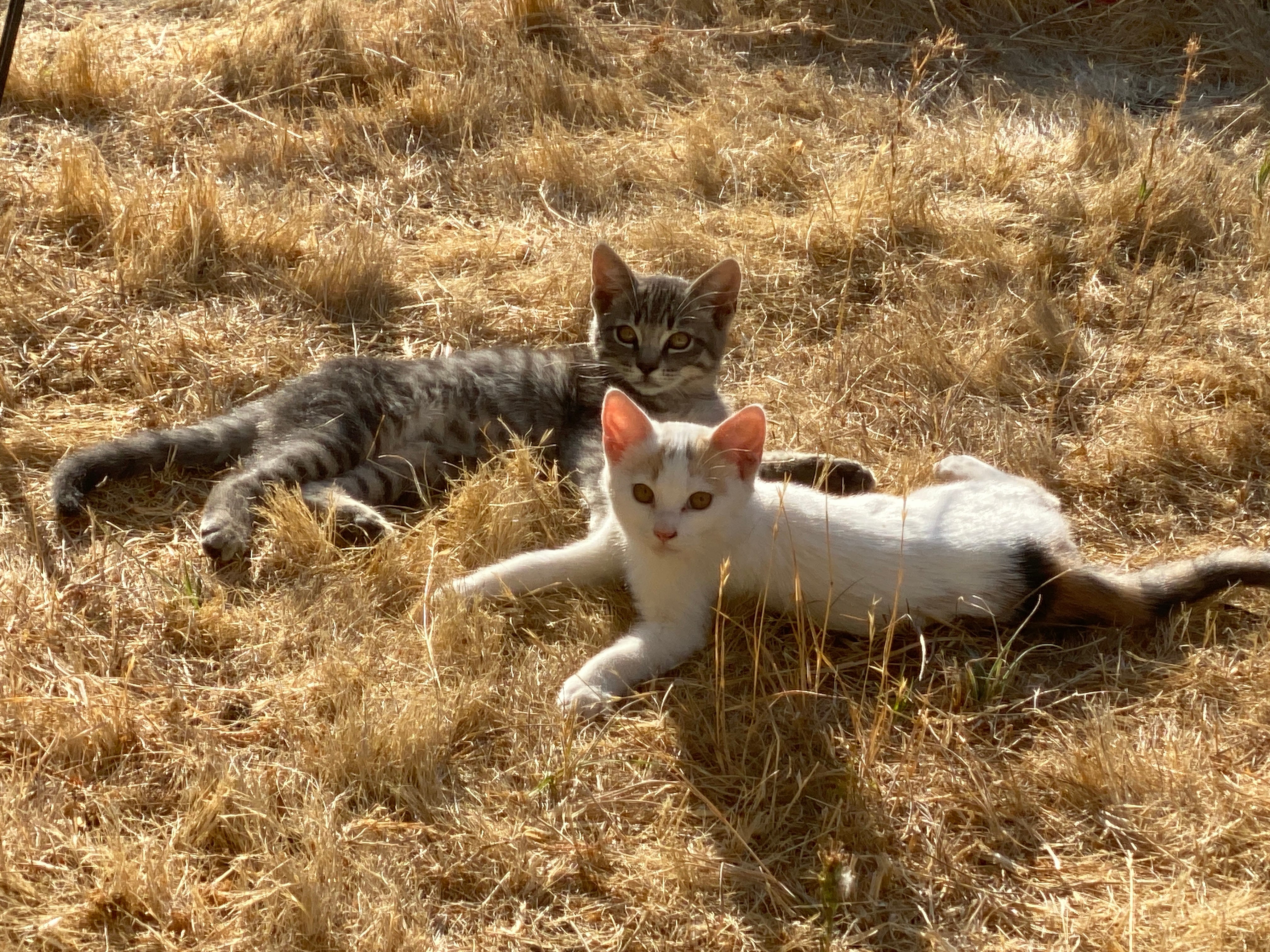
These two kittens in some ways define the shape of the second half of this year for me. I’ve waited as long for something worthwhile to say about them.1 I find them deeply interesting but it can feel pathetic to try and convey to the outside world this sort of internal fascination. Which for me actually expands to all cats everywhere all the time. Will I ever formulate that unifying insight on the perfection of cats? Without a strong thesis volunteering itself, I’m pivoting to something lazier. Collecting thoughts from the junkyard of ideas and quotes I’ve jotted down over the past months.
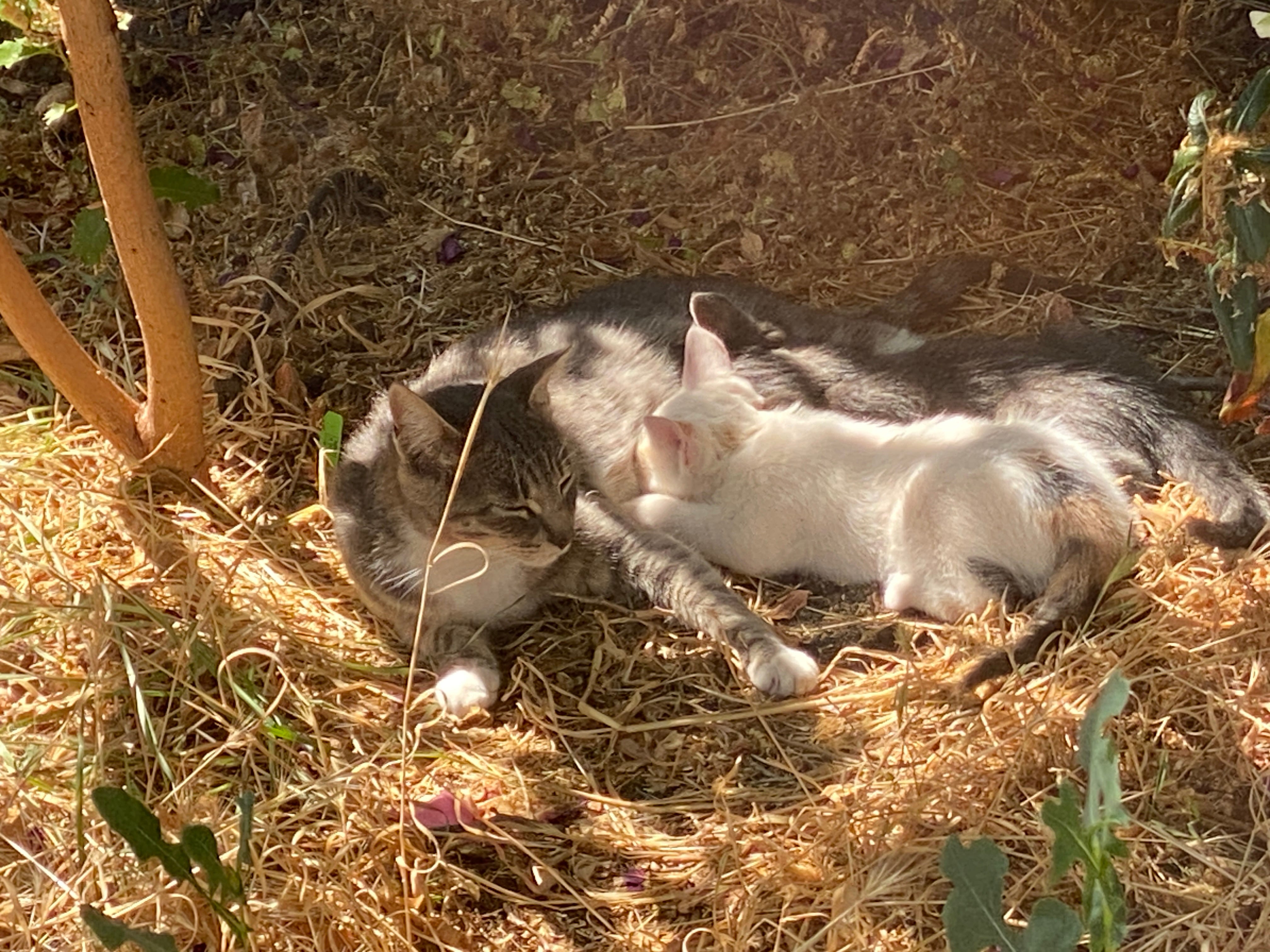
Many of the thoughts captured in my notes of late relate to these animals, and animals in general. The epicenter of the thought generation would be the place on the ground in the backyard, under my kitchen window, where the two kittens were raised starting around late June. How easily overlooked are the mundane miracles that pile up around us over the course of a life. Embarrassingly maudlin remarks on this small family of cats carrying on their basic lives abound in my notebook … ‘I’ll never contend with the wholeness of a mother cat nursing her young.’ Yikes. But I mean, look at them.
Most of the observations I’ve encountered this year concerning the wonders of animalia have come from an ensemble of incredible women I’ve been reading; Emily Dickinson, Virginia Woolf, Sylvia Plath, Annie Dillard, Ursula Le Guin, Marilynne Robinson, Mary Oliver, Marie Howe, Maria Popova (merrily we row along). But toward the end of the year, another voice with a lot to say on the subject has elbowed right to the fore (innit just like a man to?). David Abram’s writing is lending me a vocabulary to form more complete sentences about the interrelationship of earth’s creatures. In the grips of recency bias, I find myself parroting his style in my own thought processes. Abram’s words on intersubjectivity,2 the ‘consensus among a plurality of subjects,’ fit so well to my animal convictions that they might as well be my own.
The mutual inscription of others in my experience, and (as I must assume) of myself in their experiences, effects the interweaving of our individual phenomenal fields into a single, ever-shifting fabric, a single phenomenal world or ‘reality.’
- Abrams, The Spell of the Sensuous
I take his plurality of subjects to be all perceiving beings; humans and animal counterparts. No need for that particular distinction, really. While we often set ourselves counter to the parts of nature that surround us, that’s a narrow and impoverishing framing. We are in the larger frame together, richly, and less different than we are alike to an outside observer. My notebook is full of scribbles from past months wherein I make this case to myself through the lense of cat + me interactions, written about mostly in an overwrought mess of symbolic, philosophical, and pseudo-physics language…3
Our overlapping perceptual and cognitive fields give shape, color, and texture to our shared world… like projector transparencies of maps with interlocking outlines, affirming our conception of things, telling us we are on the right track. We world-build together…
fates braided. glancing bodies. spin charge flavor. for all our difference we interact … them in my orbit. i in theirs. life at the same time. a shared gravitational center about which we revolve. tethered ribbons around a maypole, weaving.
Prediction-error-correction-repetition. This is how conscious beings construct theories of outer reality, and how the solidity of the material world takes its shape in minds and helps us to navigate life in space, despite intransigent nearsightedness. When a mental model proves reliable across minds and species, in that the external stimuli that we experience seem to exert similar force on other beings, we peer beyond the confines of (specist) solipsism (the boundaries of the platonic cave?) and find there is a shared reality outside ourselves… Constellations of overlapping subjective fields end up summing to the one hyperreality we, the subjects in subjective, share.4
The love within us and the love without
Are mixed, confounded; if we are loved or love,
We scarce distinguish.
- Elizabeth Barrett Browning
To a certain disposition—shared by Dickinson, Le Guin, Dillard, Oliver, me—thoughts on shared lives can’t help but commingle with thoughts on death. And on shared earth. The earth being through time a salient symbol of death, but also of rebirth and life, in the way that earth begets life, and bodies nourish bodies. I’m closing this discursion with a salvo of earthy, deathy, nature stuff from some of the muses of 2025.
there is still
somewhere deep within you
a beast shouting that the earth
is exactly what it wanted
- Oliver
Her concern with landscapes and living creatures was passionate. This concern, feebly called “love of nature,” seemed … to be something much broader than love. There are souls … whose umbilicus had never been cut. They never got weaned from the universe. They do not understand death as the enemy; they look forward to rotting and turning into humus. It was strange to see [her] take a leaf into her hand, or even a rock. She became an extension of it, it of her.
- Le Guin, The Dispossessed
But these are the woods you love
Where the secret name
of every death is life again
- Oliver
We never know we go—when we are going.
We jest and shut the door—
Fate following behinds us bolts it
And we accost no more.
- Dickinson
the earth of your body
where no memory fails to grow
into something
a blossom in a strange place
a withered root . rhizomal decay
rare earth . common earth
compounded into this briefly persisting
myth of a vessel(self)
- me5
Here is a recent kitten dispatch: I oriented the beginning of my holiday plans around getting them to a community clinic on the 23rd to be ‘fixed,’ vaccinated, and chipped, only for them to evade capture the day of the procedure (which took months to schedule), leaving me to enter the clinic that morning with two traps empty of cat and full of humiliation. The saga continues into 2026.
The Spell of the Sensuous. Perception and Language in a More-Than-Human World. Thanks Dad! This book couldn’t have found a more receptive audience.
Speaking of which, here goes a not-quick digression (more cats + amateur philosophy):
A SodaStream bottle stuffed with cut flowers sits on the sill, backlit with the faint low-angle sun of a winter morning. The flowers are old, stalks bent, decaying to the point of blossoms of mold crowning their own blossoms. The cat in his thick winter coat nudges around the makeshift vase on the sill toward the cool windowpane behind, glistening with condensation from a night’s steady breath. Breath which must eventually fill the entire room, pushing heavily even against the window where its forced to give up its moisture.
The cat prefers water from unusual sources and in this instance sets about licking condensation off of the pane with long rough tongue strokes, one after the other. A sort of reverse painting process, he removes liquid in a pattern of tongue impressions blooming from a central point and extending out to as far as his head can reach in all directions. Now there is a clean transparent negative pressed on the window. An un-painting of dry glass on wet glass, illuminated by the blue sky and quaking dead leaves outside that present a perfect backdrop for the bouquet of withering flowers.
Apparently there really are rigorous philosophical arguments supporting the simulation hypothesis (basically: ‘simulations… we are in one!)’; arguments taken seriously by and even formulated by leading intellectuals and not just dormroom stoners. Annie Dillard in Tinker Creek points out how profligate nature is. This seems reason enough to dismiss the simulation hypothesis. Like, an engineered world would simply not be allowed to waste so much computing power on complex, idiosyncratic, and ultimately unnecessary details like tiny colonies of mold overtaking the decaying heads of carnations and zinnias. The joules and bytes would be spent more parsimoniously in a simulation than how they are in this material world.
The most persuasive piece of logic I heard in favor of us existing only as virtual beings in an entirely digital universe explains the likelihood as a simple matter of probabilities–calculable ones I guess. It was put forward credibly by Bostrom. In essence technologically advanced civilizations eventually develop powerful computational machines capable of robust simulation. Isn’t ours proof? We have computer models and games for nearly everything it seems, and they only appear to grow more powerful and totalizing as time advances. Within such civilizations, the argument goes, eventually a simulation engine indistinguishable from, or even more real-seeming than, base reality will be achieved, and then another and then, recursively, inside of some simulations will be born yet more simulated worlds, and in those, others, and so on, until in the space of all possible worlds, material and virtual, the vast preponderance of realities will be, in fact, simulations. The probability then that the reality in which one lives is the fundamental material one is vanishingly small.
All quite convincing except that some equally credible statistical argument has apparently been offered that shows some flaws in the original logic and arrives at something like a 10% chance that we live in a simulated reality rather than 99.9%. Yet this morning, for me, the white mold, the rustling leaves, the napping cat exhaling his particular kind of pungent breath, the dripping faucet, the unfinished edges of the tile backsplash, the occasional click and whir of the fridge compressor; all of this beguiling specificity is enough proof to refute the simulation hypothesis. In all the waste and excess, fine lines and discrete boundaries, all the squalid attention to detail, this world betrays itself as the realest one. To feel it is to just kind of know it… (tempting to say ‘à la Descartes’).
As Blake put it, ‘all Sublimity is found in Minute Discrimination.’
This by they way sounds extremely derivative of Spell of the Sensuous… it at least confirms I am paying attention when I read. What I was going to say is that perhaps the emitted fields of subjectivity include others of varying strengths from organic assemblies along the range of complexity on either side of ontogeny. From single cells to mycelia, forests, the whole biome… worth a thought.
Based on the location of this poem in my notebook it seems it was sparked by something Sally Rooney (another muse!) wrote about a character in Normal People: ‘things that happened to her then are buried in the earth of her body.’